Big, breath-taking sharks or majestic sea turtles often are the attention-grabbers when visiting one of Point Defiance Zoo & Aquarium’s two aquariums. But there are hundreds of underrated little ocean animals that deserve a few minutes of your curiosity. Over the coming months, we’ll highlight some of the small but mighty animals that might go unnoticed on a quick glance in the water and share what makes them so unique.
June Highlight: Sea gooseberry
This little, translucent comb jelly resembles a floating marble. Sea gooseberries move by using eight rows of microscopic hairs, called cilia. As the cilia moves to propel the sea gooseberry, they refract light and cause a shimmering rainbow effect. Despite looking fragile, sea gooseberries are ravenous carnivores that can eat up to 10 times their body weight each day. They typically eat copepods, eggs, larval fish, krill and small crustaceans. They have two long, sticky feathered tentacles that they use to catch their prey because they cannot sting like other jellies. They then reel in their prey and spin to bring their mouth closer to their catch. Like other jellies, they lack a brain, heart, blood and bones. Every sea gooseberry has both male and female reproductive organs and reproduce by sending out both sperm and eggs into open water. Check out these shimmering animals in the Pacific Seas Aquarium jelly habitats.

May Highlight: Strawberry anemone
This tiny pink anemone lives in high current areas all along the rocky parts of the West Coast, from British Colombia to Mexico. They can also be purple, orange or white in color. Standing about one inch tall and one inch wide, they typically clone themselves, forming high concentrations in a small area.

They can also reproduce by sending out sperm and eggs. Their transparent or white tentacles don’t retract like other anemones and the tips on their tentacles, and sometimes their spots along the rest of their body, resemble the seeds of a strawberry, hence its name. But despite their name, strawberry anemones are more closely related to corals than sea anemones. They just lack the hard exterior.

They use their stinging cells to capture food – like plankton, copepods, larvae, small crustaceans, and invertebrates – and defend their territory against other anemones. Find strawberry anemones throughout the Pacific Seas Aquarium, but get an up-close view of them in the Puget Sound Color habitat.
April Highlight: Suberites latus with hermit crab
This month’s featured animal is actually two animals that have a symbiotic relationship – they have a long-term beneficial partnership. Suberites latus is a species of sea sponge that is typically yellow, orange, or gray in color.

Suberites latus settles on the shell of some hermit crabs and dissolves the calcium carbonate of the shell without dissolving the crab. They then grow with the hermit crab, making it so the crab doesn’t have to find a bigger home as it grows, too. The sponge provides lightweight protection for the hermit crab and benefits from the crab moving across the sea floor.
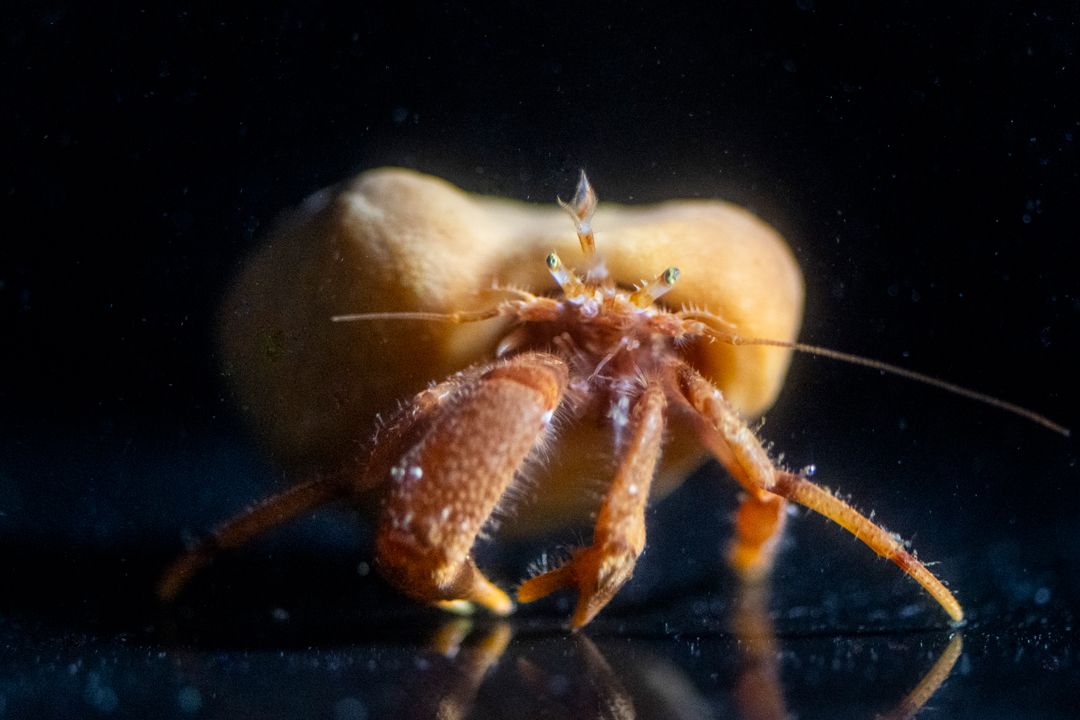

Sometimes known as the hermit crab sponge, they live along the Pacific coast and are filter feeders, eating bacteria and phytoplankton. They also contain neurotoxins to deter predators, although some specialized animals can prey upon them, like some nudibranchs. Find suberites latus with its hermit crab friend in the Puget Sound Color habitat in the Pacific Seas Aquarium.
March Highlight: Moon Jelly
Moon jellies live throughout the world’s surface waters, except for the coldest parts of the Arctic and Antarctic oceans and are often found over reefs and along the coasts. During summer in the Puget Sound, they form groups called “smacks” that are large enough to be seen from low-flying planes. Scientists are tracking them to see how they might be affected by changes in ocean temperature.

Moon jellies are translucent but can appear to change color depending on whether and what they’ve eaten recently. They primarily eat tiny zooplankton, so they don’t need a strong sting, which typically won’t hurt a person. When their stinging tentacles along the edge of their bell catch and stun their prey, the long, frilly “mouth arms” collect the food and pass it up to their mouth. Moon jellies do not have a brain, heart, backbone, or eyes, but they can smell, taste, and sense light.


Most people are familiar with the drifting “medusa” form of jellies, but many jellies, including moon jellies, also have a secret seafloor life, where they live as little anemone-like “polyps” attached to rocks. At dawn or dusk, adult jellies—the “medusa” form—release sperm and eggs, which then combine. Female moon jellies take up the sperm through their mouths to fertilize internally. The fertilized eggs then develop into tiny free-swimming larvae. The larvae settle on the underside of docks or on rocks and grow into polyps, which use their tentacles to catch zooplankton. The polyp then develops clones of stacked, frilled discs that break off and drift free—forming baby jellies. The babies grow into the adult medusa form and continue the life cycle.
February Highlight: Grunt Sculpin
Grunt sculpins are small, armored fish with large heads, tiny spines, and tapered snouts. They grow to be about three inches long and often hide in crevices or empty shells (look inside the giant barnacle shells in the Home Sweet Barnacle habitat at the Pacific Seas Aquarium).
 When hiding in an empty barnacle shell with only their snouts sticking out, they look like a closed barnacle. They aren’t the best swimmers, so they use their bright orange or red pectoral fins to “walk,” “hop,” or “crawl” along the sea bottom or over rocks.
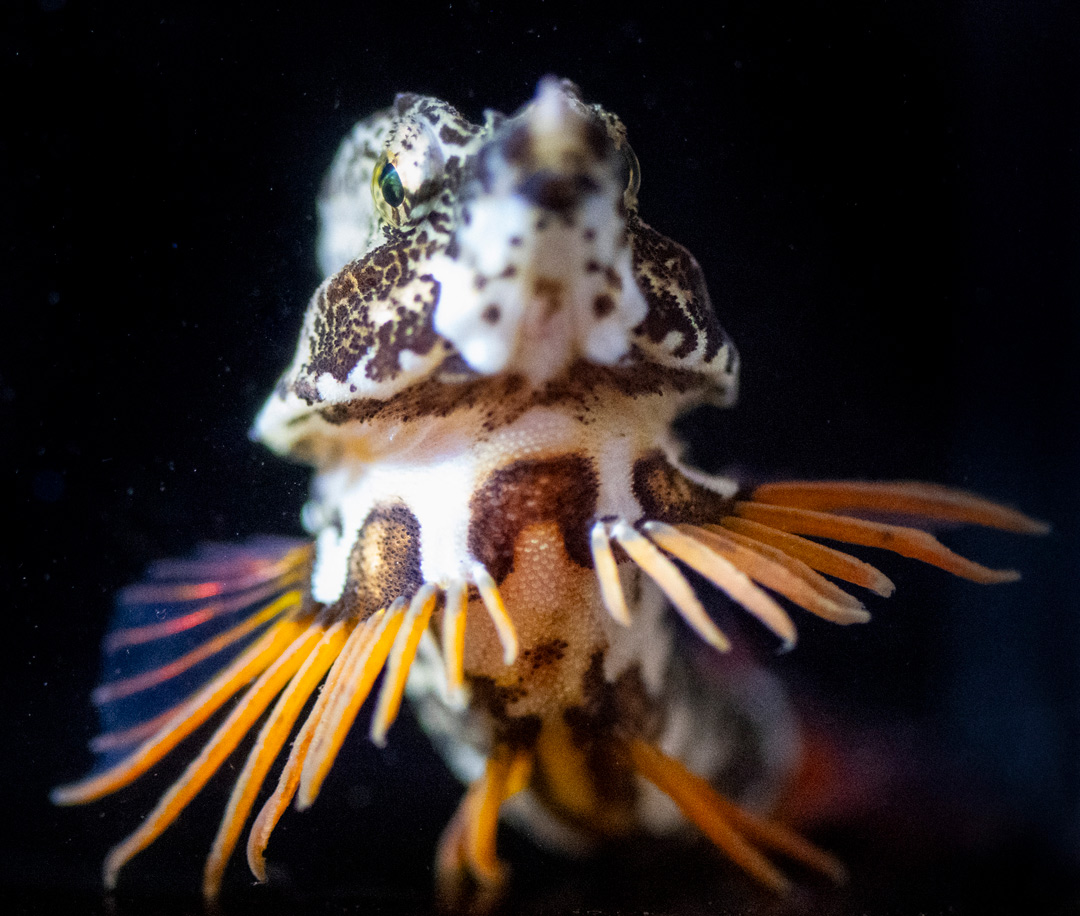
Their diet includes crustaceans, fish larvae, and zooplankton.

When female grunt sculpins are ready to mate, they will chase a male into an empty barnacle, lay up to 150 eggs, and block the male from leaving until he fertilizes the eggs. After they are fertilized, the female leaves the male to guard the eggs. She will occasionally come back and take a shift guarding them. When the eggs are ready to hatch, one of the parents will take them in their mouth and spit them out, breaking them open.
