Get ready for some Halloween fun! We’re featuring spooky (and not-so-scary) species from our Pacific Seas Aquarium and Tropical Reef Aquarium. Keep an eye out for these amazing fish and invertebrates on your next visit to the zoo!
Skeleton Shrimp (Caprella mendax): These amphipods cling to various substrates, waiting to catch plankton drifting through the water, much like a praying mantis. Their body color varies depending on the habitat to provide camouflage, and they shed their exoskeletons to grow. You can find skeleton shrimp in the surge tank outside the Pacific Seas Aquarium or the Tidal Touch Zone inside the aquarium. 

Moon wrasse (Thalassoma lunare): This creature is carnivorous and preys on fish eggs and small sea-floor-dwelling invertebrates. It is adorned with iridescent spots and stripes and is noted for being bold and fearless of divers or larger animals. They can be seen swimming in open water and foraging over reefs. Find moon wrasse in the Lagoon habitat in the Tropical Reef Aquarium.
Blue devil damselfish (Chrysiptera cyanea): Beware the captivating presence of these little creatures, for they can be aggressive and fiercely defensive of their territory. The males boast vibrant yellow hues, while the females have semi-transparent, ghostly tails. Find blue devil damselfish in the Outer Reef habitat in the Tropical Reef Aquarium.

Round batfish (Platax orbicularis): Round batfish consume algae and other invertebrates such as jellies or plankton. They are also known to imitate debris or leaves in the water to evade predators. Find round batfish in the Outer Reef habitat in the Tropical Reef Aquarium.

Slime Star (Pteraster tesselatus): This local species of sea star can vary in color and has a central pore for water circulation. It can release significant amounts of slime as a defense mechanism against predators. Find slime stars in habitats in the Pacific Seas Aquarium.

Pacific Blood Stars (Henricia laviuscula): Pacific blood stars are a smaller local species of sea star, typically bright orange-red in color. They feed on sponges and tiny bacteria. You can find Pacific blood stars in habitats within the Pacific Seas Aquarium.

Wolf Eels (Anarrhichthys ocellatus): What large teeth you have! These fish possess powerful jaws with large molars for crushing food with hard shells, such as sea urchins, mussels, and clams. Find wolf eels in the Narrows habitat in the Pacific Seas Aquarium.

Spotted Ratfish (Hydrolagus colliei): These chimeras possess a venomous spine at the base of their dorsal fin, which can cause severe pain and injure or kill potential predators. Find spotted ratfish in the Northwest Waters habitat in the Pacific Seas Aquarium.

Scrawled filefish / broomtail filefish (Aluterus scriptus): Filefish are versatile eaters, indulging in a diverse array of items around reefs, such as crustaceans, algae, sponges, corals, and whatever else piques their curiosity. These fish are also capable of changing color. Find scrawled filefish in the Lagoon in the Tropical Reef Aquarium.

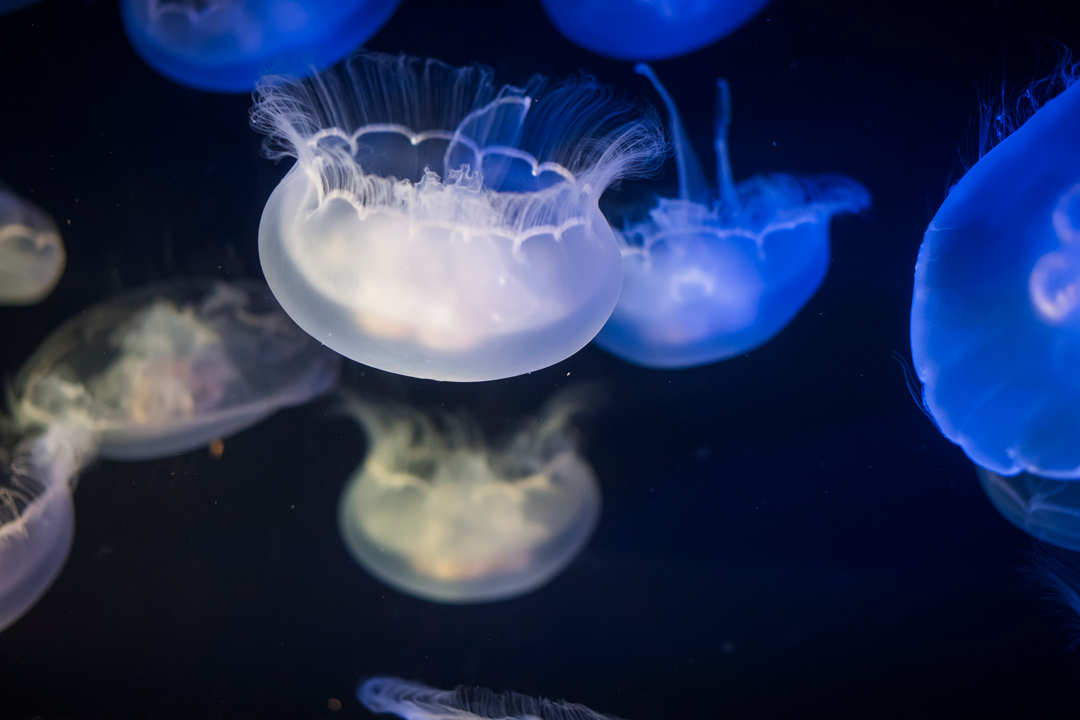
Moon Jellies (Auralia labiata): These jellies are primarily translucent and have a moonlike bell giving their name. They can be found in large aggregations in Puget Sound and along the coast. Find moon jellies in the Pacific Seas Aquarium, where they show off their eerie moonlight glow.