One of the most fascinating stops on a walk through Point Defiance Zoo & Aquarium is a 12-foot conifer that looks like it stepped out of prehistory. It stands out among Washington’s evergreens with light green, widely spaced needles, oddly sparse branches, and enormous, knobby cone balls. It’s the Wollemi pine, a tree once thought extinct for millions of years.

Bryon Jones, lead horticulturist at Point Defiance Zoo & Aquarium, is especially proud of this relic.
“It’s pretty rare to find them around here,” Jones says. “And ours are apparently some of the largest in the area.”
An ancient member of the Araucariaceae family, the Wollemi pine dates back over 200 million years to the early Jurassic period when dinosaurs roamed the Earth. For decades, scientists believed it existed only in fossil records. Then, in 1994, an Australian bushwalker made a history-making discovery: a small grove of living Wollemi pines hidden deep in a remote canyon within Wollemi National Park, west of Sydney.

The scientific world was stunned. A species believed extinct for millennia had been found alive — earning the Wollemi pine the nickname of a “Lazarus species” a term for organisms that reappear after vanishing from the fossil record.
Since its rediscovery, the exact location of the wild Wollemi grove has been kept top secret by a handful of Australian scientists to protect the critically endangered trees from poachers, disease, and human impact. That secrecy became especially critical in 2020, during Australia’s devastating bushfires, when a covert firefighting operation was launched to save the last 200 wild Wollemi pines. The successful rescue made global headlines and renewed awareness of the tree’s importance, not just as a botanical marvel but as a symbol of conservation itself.
Today, thanks to careful propagation by horticulturists, Wollemi pines have been cultivated in limited numbers and shared with gardens worldwide, including ten thriving specimens right here at Point Defiance Zoo.
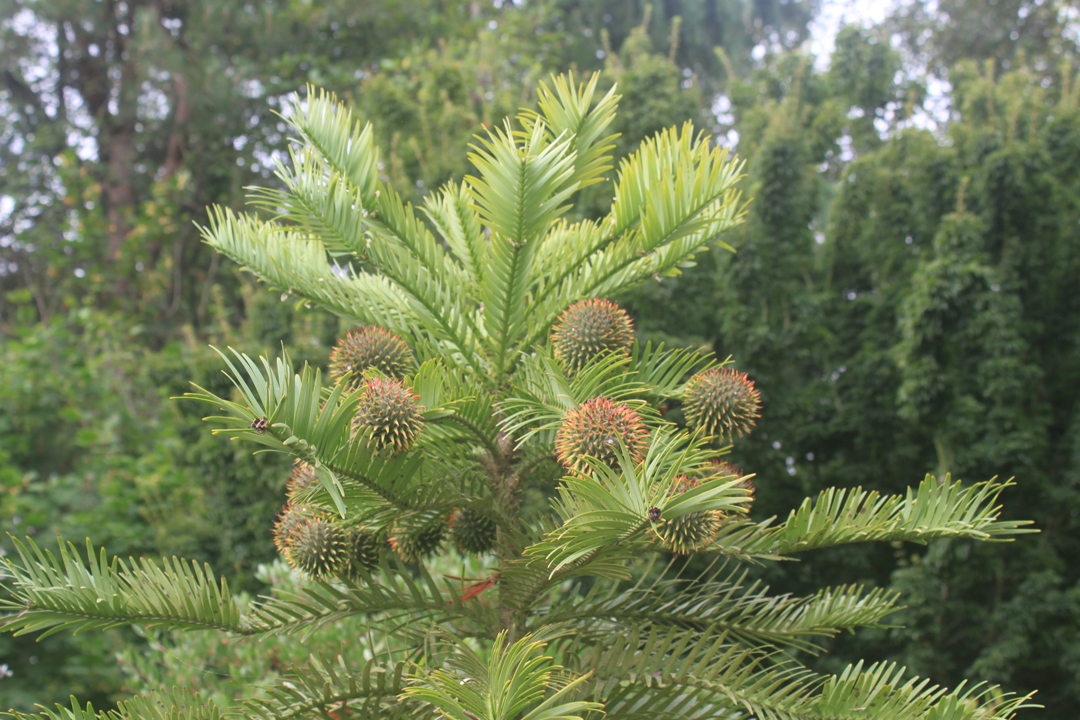
The tree has a distinctive, bubbly, dark brown bark, often compared to chocolate cereal or “cocoa puffs.” It can grow both male and female cones on the same tree. It can clone itself by sprouting multiple trunks from its base, a survival strategy that has helped it persist through millions of years of dramatic climate shifts and mass extinctions.
“Its survival for over 200 million years, through dinosaurs, ice ages, and wildfires, is a testament to the species’ hardiness and adaptability,” says Jones.
Find Them at the Zoo:
- Three trees are located just off the path to the right of Kids’ Zone.
- One is in the sloped planting bed between the old aquarium and the Wild Wonders Outdoor Theater.
- One tree sits between Penguin Point and Wild Wonders.
- Two trees are in the Asian Forest Sanctuary—one large, one small.
- A smaller tree is planted in the bed across from the Wild Wonders Outdoor Theater exercise yard.
- Another small tree is located in the curve opposite the large oak tree, on the path leading down to the Wild Wonders theater.
- One tree is in the bed behind the Zoo Society Kiosk.
Don’t miss the chance to see one of the rarest and most ancient trees on Earth. Its incredible backstory reminds us how much of the natural world remains mysterious and how important it is to protect it for the future.