Walking side by side, kindergartners and second graders from South Tacoma’s Arlington Elementary buzzed with excitement as they crossed the street like rows of ducklings, heading toward Oak Tree Park on a sunny June day. The park is a special place, a living classroom, where they’ve spent time learning about nature, science, and caring for their community.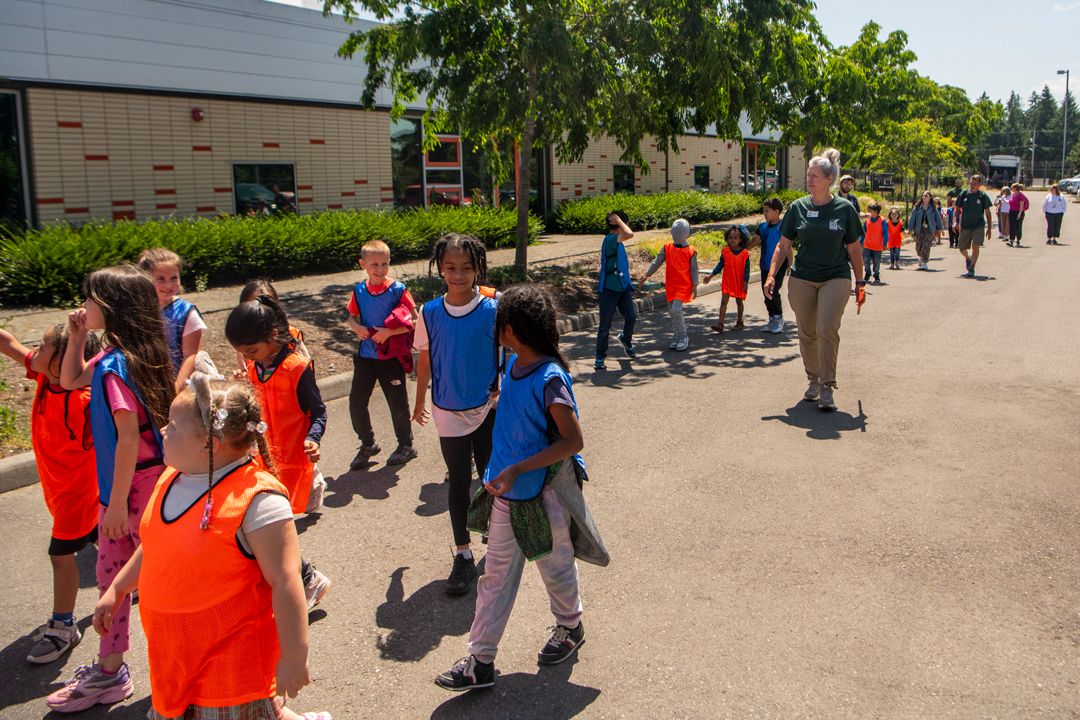

It was Buddy Week at Arlington, a tradition where older students are paired with younger ones to foster friendships, mentorship, and shared adventures. This visit marked their final trip to the park for the school year.
All the students are part of the Wildlife Champions program, a long-term collaboration between Point Defiance Zoo & Aquarium, a facility of Parks Tacoma, and Tacoma Public Schools. Both Arlington and Lister Elementary participate in the program.

Sunlight filtered through the thick branches of the Garry Oak trees, casting playful speckles on the forest floor. There, the children learned they would be making nature bracelets from items found on the ground—as long as nothing was still alive.
“This is probably the first time we can say you get to take something home from Oak Tree Park,” said Liz Hines, the Point Defiance Zoo & Aquarium’s Community Engagement Coordinator, who led the day’s activities.

Wildlife Champions helps kids learn about science, nature, and the environment while practicing empathy for wildlife and being good stewards of their schools, neighborhoods, and local parks. The award-winning program was created through a unique collaboration between Tacoma Public School teachers and environmental education experts from the zoo, blending empathy and scientific principles to enrich nature and wildlife education.


With wide eyes and tape wrapped around their tiny wrists, the kids eagerly scanned the forest floor for natural treasures like delicate leaves, shiny stones, gnarled twigs, and soft moss. “Not the ants, though!” one student reminded the group.
After filling their bracelets with nature’s wonders, it was time for a game inspired by their recent lessons on biomimicry. Just as humans have studied birds to invent airplanes or examined polar bear paws to design better snow boots, the kids were about to mimic nature through movement.

Jacob Meyers, the zoo’s Community Engagement Specialist, gathered everyone into a circle of tall grass.
“Someone on the outside will be our leader,” he explained. “So if I start patting my head, you all copy me.”

The kids did just that, patting their heads with glee. Understanding biomimicry was simple—but keeping the leader’s identity a secret? That was the real challenge.
Meyers picked two buddies to stand in the center and close their eyes while he quietly chose the leader. One by one, new leaders hopped like bunnies, kicked their feet, and patted their bellies. The circle echoed their moves, while the center pair tried to guess who started the mimicry.

Even though there was a lot of peeking, whispering, and pointing, the game was engaging and educational, and there were a lot of giggles.
“They love it when Mr. Jacob comes into the classroom,” said second grade teacher Ms. Parrish. “They get excited because they know they’re going to do something fun. I think a lot of kids are stuck at home on devices. Going to the park isn’t part of their daily lives. This lets them burn off energy and discover things they may never have seen before.”

A few kindergartners were dazzled by a broken eggshell and a sprawling ant colony. A day at Oak Tree Park is always an unscripted adventure.
After making nature bracelets and playing the mimic game, the kids raced to the playground, climbing, laughing, and decorating the pavement with happy chalk art before heading back to school.

Second-graders Elena and Isabella reflected on their experiences as Wildlife Champions. They talked about learning how seeds become plants and how to care for them. “I like lessons in the park,” Isabella said. “You can see what we’re learning about. It makes it easier.”
Hines said one of her favorite parts of the program is watching it grow and helping teachers bring wildlife-centered lessons into the classroom.

Meyers emphasized that Wildlife Champions is, at its core, about community. “Many of these kids are introduced to our parks through this program,” he said. “We want them to know: ‘You belong here. You’re part of this.’ That’s like a seed that grows over time—and for me, that’s what it’s all about.”

Oak Tree Park is full of lessons—big and small—like the ancient Garry Oaks that have stood there for over a century, and like the young, curious students who explore beneath their branches with wide eyes and open hearts.