For weeks, Lakina the walrus had kept her right eye tightly shut. Despite pain medications, the 9-year-old Pacific walrus at Point Defiance Zoo & Aquarium refused to open it, leaving keepers and the zoo’s veterinary team concerned.

“She was holding her eye closed and was uncomfortable,” said Dr. Karen Wolf, the zoo’s Head Veterinarian. “We didn’t know exactly what was irritating the eye. Pain medications didn’t help. That’s when we knew we had to immobilize her to get answers and provide treatment.”
Like many pinnipeds, walruses are prone to pinniped keratopathy, a range of degenerative corneal diseases. Lakina’s parents suffered from chronic eye conditions, so Dr. Wolf speculated there might be a genetic link.
“The ophthalmologist we are consulting with noted that Lakina’s parents developed ocular disease when they were young,” said Dr. Wolf. “Unfortunately, we weren’t surprised to see something similar showing up in Lakina.”
But treating a walrus’s eye isn’t as simple as it sounds.
“You can’t just pry open her eyes,” Dr. Wolf said. “The eye muscles of a walrus are incredibly strong. We knew we had to sedate her, and that comes with a whole new level of complexity and risk.”
To handle the delicate procedure safely, the zoo flew in Dr. James Bailey, a board-certified veterinary anesthesiologist known for his expertise in marine mammals.

“Anesthetizing a walrus is no easy task,” Dr. Wolf explained. “Their unique physiology and large size make anesthesia challenging. Keeping them adequately ventilated is imperative and you need to regularly measure blood gases and arterial blood pressure and be prepared to intervene. They can develop nerve or muscle damage from lying in one spot too long. They lose body heat over time and keeping them warm can be challenging. There are so few people who specialize in this. We flew Dr. Bailey in because he’s simply the best.”
Alongside Dr. Bailey was Dr. Carmen Colitz, a board-certified veterinary ophthalmologist who’s no stranger to Lakina’s family. She had treated Lakina’s parents years earlier for similar eye conditions. She is also an expert in pinniped eyes, having authored many journal articles and book chapters on the subject.

“Dr. Colitz found an ulcer in Lakina’s right eye,” Dr. Wolf said. “It was serious enough that she had to debride it (scrape off the dead tissue to promote healing) and intervene surgically.”
Dr. Colitz performed grafts using Lakina’s conjunctiva (the membrane that lines the eyelid and covers the white of the eye) along with an amnion graft to cover the ulcer.
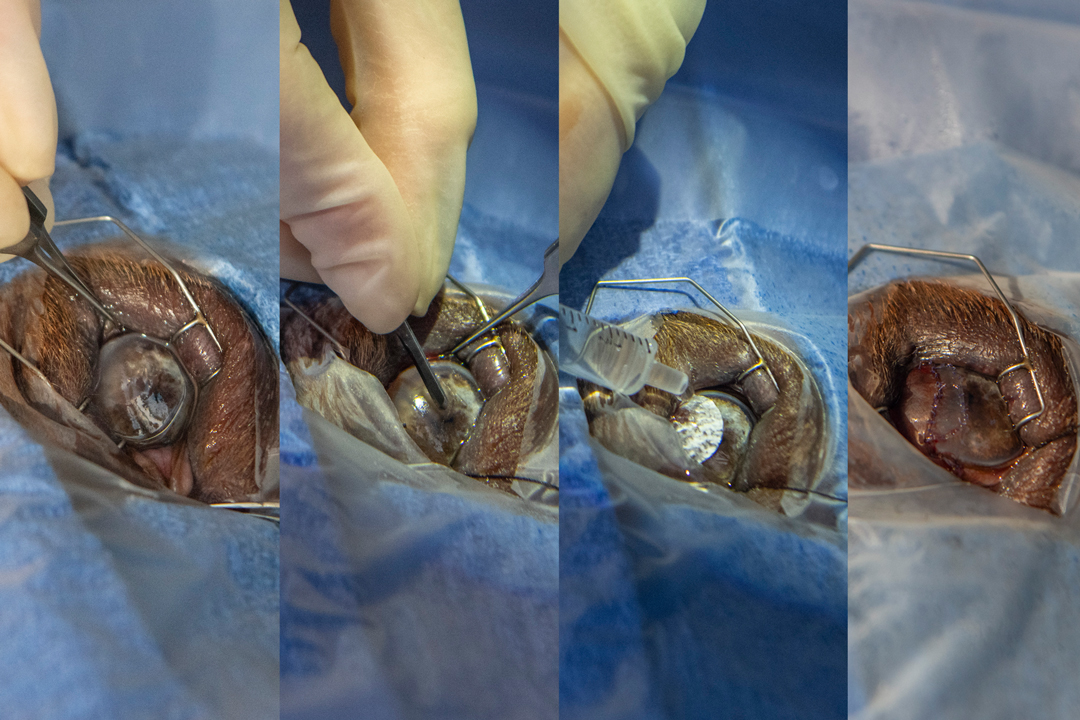
“We’re hopeful that, over time, she’ll start to accept eye drops again,” Dr. Wolf said. “But for now, we’re doing everything possible to support healing.”
Lakina is now on oral antibiotics, recovering in her habitat under close observation from the veterinary and animal care teams.

“She’s a tough animal,” said Dr. Wolf. “We’ll keep monitoring her progress closely. Hopefully, she’ll feel better soon, and maybe even open that eye again.”
Behind the scenes, it took an enormous effort to make the procedure possible.

“The amount of work that goes into immobilizing a walrus is incredible,” said Dr. Wolf. “All the equipment that has to be moved, supplies that need to be ordered, and the coordination between departments—from operations to animal keepers to veterinary technicians and veterinarians—it’s a massive team effort. Everyone plays a critical role.”


