Just down the road from Point Defiance Zoo & Aquarium, along the docks of the Point Defiance Marina, a dedicated team of zoo staff and volunteers are playing a vital role in an important marine research effort. Since 2022, the zoo’s conservation team has partnered with the Pacific Northwest Crab Research Group (PCRG), contributing to a long-term regional study aimed at better understanding the population of Dungeness crab.

Several times each week during the spring and summer, members of the Point Defiance Zoo team head down to the marina to retrieve a light trap deployed beneath the dock. These simple traps, crafted from water coolers and fitted with funnels and an LED light on a sunset-to-sunrise timer, mimic the glow of moonlight to draw in planktonic creatures which are naturally attracted to light.

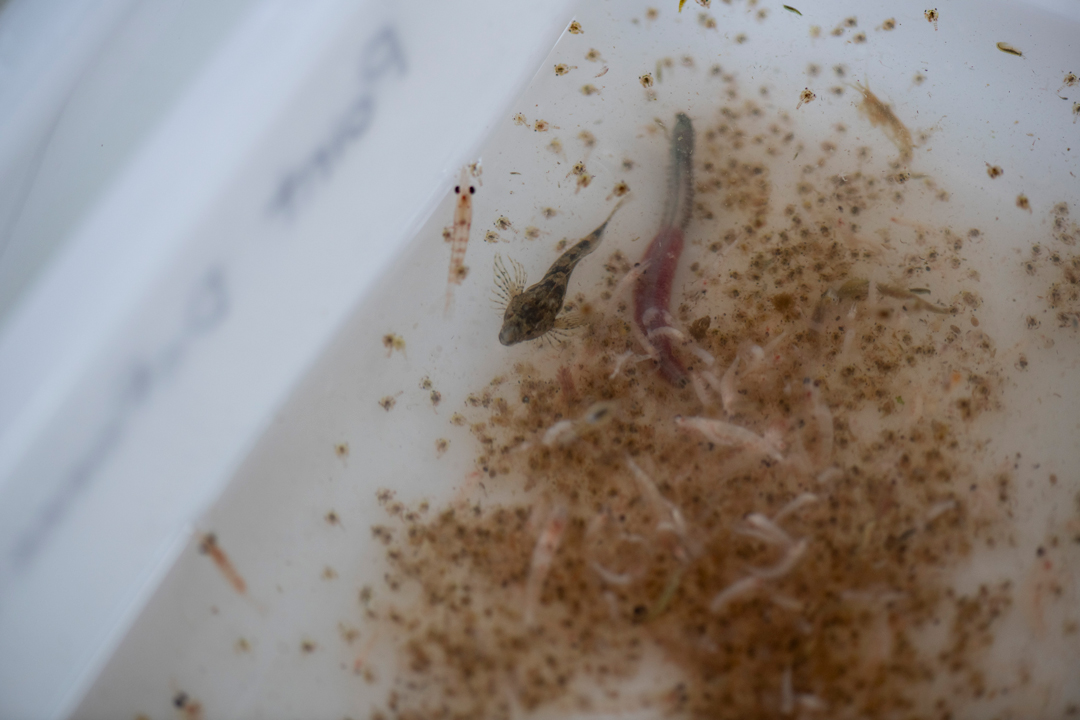
Once retrieved, the trap’s contents are poured into buckets for sorting and analysis. Volunteers and staff identify and count the various species collected, with special attention given to the number of Dungeness crab larvae. Once data is recorded, all organisms are returned to the waters of Puget Sound.

“It’s amazing what we find in these traps,” said Zachary Hawn, Conservation Coordinator at Point Defiance Zoo & Aquarium. “We get to see not only Dungeness crab larvae, but a whole range of planktonic life that helps us better understand the health of our local marine ecosystems.”
From April to June, the team is joined by marine biology students from Tacoma Public School’s Science and Math Institute (SAMi), which is uniquely located right in the heart of the zoo grounds. These students gain hands-on experience by helping monitor and analyze the light trap catches at the marina.
Science teacher Matthew Lonsdale, who teaches marine biology at SAMi, says the school helped connect the zoo to the PCRG program.

“I’ve always loved teaching about marine ecosystems, but what’s really fun is watching the kids get excited about seeing it all firsthand, especially when they realize how much is out there right off the dock,” Lonsdale said.
On this particular day in late June, even though school was out for the summer, Lonsdale continued volunteering with the zoo’s research team. You could see his passion for marine life as he carefully held up a kelp isopod for volunteers to observe before returning it to the water.

The data collected at the marina is sent directly to PCRG, who then shares it with a consortium of scientists, tribes, universities, state agencies, and community members working together to close knowledge gaps in crab biology and ecology. Since its founding in 2018, PCRG has supported research to help fisheries make informed decisions that sustain native crab populations and the communities that rely on them.
PCRG’s larval Dungeness crab monitoring project was inspired by a long-term study in Coos Bay, Oregon. That research showed that the abundance of larval crabs in a given year could predict adult crab numbers four years later. The current project builds on this model to see if the same patterns apply to Washington’s coastal waters.

Why Larvae Matter
Yes, Dungeness crabs are a favorite seafood. But they’re also a cornerstone of the Pacific Northwest’s coastal economy and culture. For generations, they’ve been part of Indigenous and commercial fishing traditions. Ecologically, they serve as food for predators like sea otters and help support the balance of marine life in the region.

Understanding where and when these crabs thrive is essential.
“Even tiny data points from individual light traps help paint a bigger picture of what’s happening beneath the surface,” said Hawn. “It’s community science at its best.”
Point Defiance Zoo & Aquarium will continue its light trap work in the seasons to come, helping to build a better understanding of Dungeness crab populations with every pull of the trap. While volunteer slots are currently filled, the zoo plans to accept new volunteers for this project in 2026.